Rancero to Inherit Development of Vizly

· 3 min read

We're excited to announce that Rancero is inheriting development and future support for Vizly, a fully themable, low-boilerplate Python charting library built on Apache ECharts.

Vizly lets you ship production-quality charts in a few lines of Python code - just pass a DataFrame to vz.line(), vz.bar(), or any of the 39 registered chart types and export with to_html() or to_option(). No nested option builders, no configuration headaches.

Why Vizly matters

Data visualization is critical for every modern application - whether you're building dashboards, monitoring infrastructure, analyzing financial markets, or embedding charts into customer-facing products. Vizly makes this trivially easy without sacrificing power or performance.

  • 39 chart types - Cartesian (line, bar, area, scatter), statistical (boxplot, heatmap, parallel), financial (candlestick, kline), geo (map, geo), relational (graph, sankey, tree), hierarchical (sunburst, treemap), 3D (bar3d, line3d, scatter3d, surface3d), and compose (page, tab, timeline, grid).
  • Easy to use - Set a theme, call vz.bar(df, x='region', y='sales', title='Sales'), done.
  • Highly performant - Vendored JS by default; GL and plugins load only when needed.
  • Native framework integrations - Streamlit, FastAPI, Flask, Django, HTMX, and Jupyter.
  • 8 built-in themes - default, light, dark, corporate, minimal, contrast, plus ops-inspired themes (ops_grafana, ops_cloudwatch, ops_kibana).
  • Worldwide maps by default - Bundled world atlas plus USA states.

Framework compatibility

Vizly ships with first-class integrations for the Python web ecosystem:

  • Streamlit - Single-chart st_vizly() and multi-chart st_dashboard() with a single ECharts iframe.
  • FastAPI - html_response(), json_response(), and dashboard_response() for endpoints.
  • Flask - chart_html() fragments and dashboard_response() for Jinja templates.
  • Django - Template tags {% vizly_chart %}, {% vizly_assets %}, and {% vizly_dashboard %}.
  • HTMX - Fragment swapping with htmx_chart_fragment() and smart full-page fallback.
  • Jupyter - Native _repr_html_() rendering in notebooks.

Critical use cases

DomainVizly chart typesExample
Ops monitoringline, area, gauge, heatmap, mapCPU/memory dashboards, request latency tracking
Financial analysiscandlestick, kline, combo, waterfallPrice action, P&L bridges, ARR waterfalls
Sales analyticsbar, pie, donut, funnel, mapRevenue by region, pipeline stages, segment mix
Data sciencescatter, boxplot, parallel, radarDistribution analysis, feature comparison
Hierarchical datasunburst, treemap, tree, sankeyProduct trees, budget allocation, user flow
Geographicmap, geoStore locations, demand heat maps
Dashboardspage, tab, timeline, gridMulti-chart views with one ECharts load

"Charts in a DataFrame in, HTML or JSON out. No nested option builders."

Vizly will be included in the Rancero platform natively, and we're committed to supporting and developing the library with community contributions.

For full documentation, visit our Vizly documentation.

Try it out: The package is published on PyPI as vizly. Imports use vz (e.g. import vizly as vz).

pip install vizly

With framework extras:

pip install vizly[streamlit,fastapi,flask,django]

Rancero to Inherit Development of inhouse Cache

· 2 min read

We're excited to announce that Rancero is inheriting development and future support for inhouse, a zero-dependency, in-process TTL cache for Python.

inhouse is designed for developers who need fast, simple caching without the overhead of external infrastructure like Redis. A single decorator is all it takes. No complex configuration, and no separate services to deploy.

Why use inhouse?

  • Zero external dependencies — No Redis, no databases, no infrastructure to manage. inhouse runs entirely in-process.
  • Stampede-safe — Per-key singleflight ensures concurrent cache misses on the same key coalesce into one computation, preventing thundering herds.
  • LRU-bounded — Automatically evicts least-recently-used entries when max_size is exceeded, keeping memory under control.
  • TTL with lazy expiry — Expired entries are cleaned on read, with an optional background sweeper for proactive cleanup.
  • Thread-safe — Safe for use with both sync and async callables.
  • FastAPI-ready — Built-in @fastapi_cache decorator with Request/Response-aware cache keys, background expiry sweeper, and clean lifespan shutdown.

How it benefits developers

inhouse eliminates the friction of setting up and maintaining external caching infrastructure. It's ideal for single-node applications, prototypes, and services where latency and simplicity matter. With inhouse, you add caching in one line of code and get production-grade features like stampede protection, deterministic cache keys, and configurable TTL policies, all without leaving your application process.

"For when Redis is a meeting you don't want to have."

inhouse will be included in the Rancero platform natively, and we're committed to supporting and developing the library with community contributions.

For full documentation, visit our inhouse Cache documentation. We will own/maintain formal documentation for inhouse Cache moving forward.

Try it out: The package is published on PyPI as inhouse-cache. Imports use inhouse (e.g. from inhouse import MemoryStore).

Core:

pip install inhouse-cache

With FastAPI helpers (fastapi_cache, lifespan sweeper):

pip install inhouse-cache[fastapi]

Object Storage Launch

· 2 min read

We're excited to announce the release of the first full-fledged end to end product on Rancero, the object storage service.

Our aim with this service is to provide a much more integrated, streamlined, and most importantly, affordable object storage platform. Unlike traditional object storage services from other cloud providers, we will not charge for ingress or egress. That means no hidden fees for bandwidth utilization. Pay for the storage you use, and that's it! No complexity or messy calculations or unexpected bills.


Object Storage

  • Launched in US East, US West, and available to some users in Canada.
  • 0.02$ USD / GiB. Flat rate.
  • Always defaults to high-performance. No toggling between high-performance or standard, or having your data get frozen in an archival after a certain period of time.
  • Create unlimited containers with unlimited subfolders and unlimited storage. Never worry about constraints.
  • No limits on regions, create any containers in any regions.
  • Host static sites on top of any container or subfolders and route directly to them without concerns on bandwidth.
  • Visible to all developers and administrators within Org/Enterprise accounts.
  • All storage encrypted by default

Stay tuned for broader availability. The Object Storage is currently in Alpha. We will roll to Beta as well as roll out our S3 API in conjunction simultaneously.

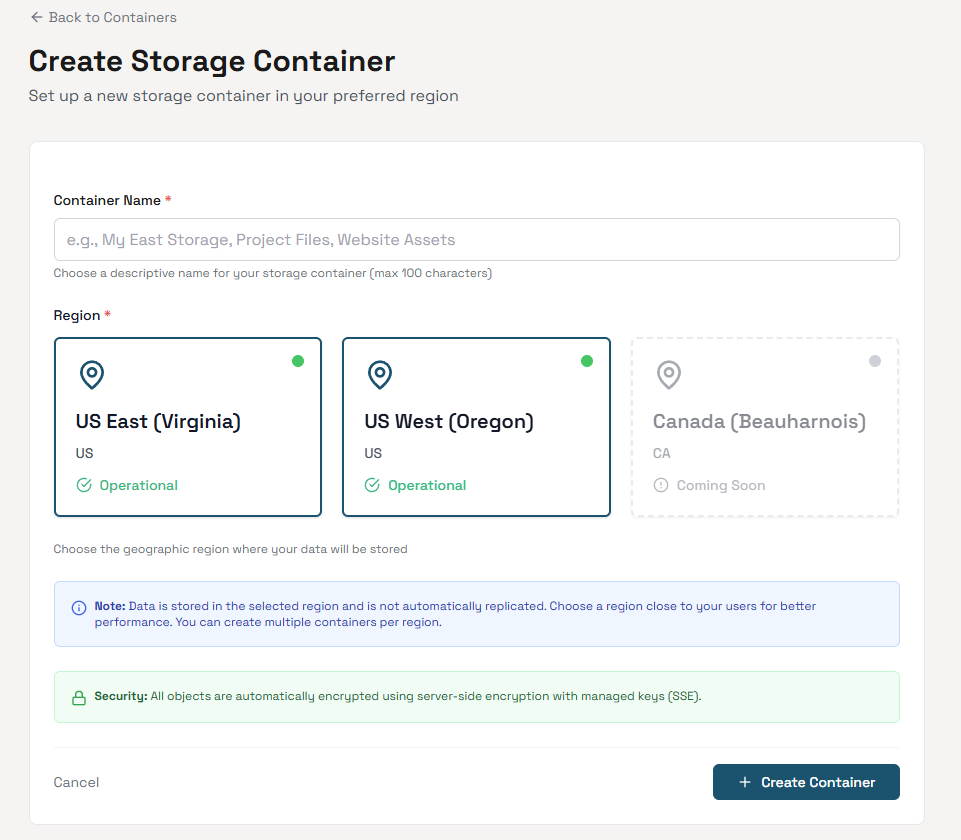
Object Storage Preview - Creating Containers

Thank you for being part of the Rancero community!

Welcome to Rancero Announcements

· One min read

Welcome to the Rancero Announcements page! This is where we'll share important updates, news, and developments from the Rancero team.

Stay tuned for regular updates about our cloud platform, business tools, new features, and company news.


What to Expect

  • Product launches and feature releases
  • Company milestones and achievements
  • Important service notifications
  • Industry news and insights

Thank you for being part of the Rancero community!